
The web-weaving behavior of two tropical species, Nephila clavipes and Gasteracantha cancriformis, was recorded with a video camera equipped with close-up lenses. Another video camera coupled with a dissecting microscope helped to determine that individual droplets of sticky glue slide along the leg's bristly hair, and to estimate the forces of adhesion to the web. By washing spider legs with hexane and water, they showed that spiders' legs adhered more tenaciously when the non-stick coating was removed.
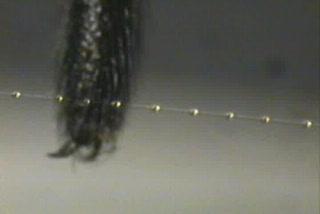
In this video of Nephila clavipes building a web, you can clearly see the pointed drip tip of the bristly hairs on the spider's leg. Tropical plants have leaves with pointed drip tips so that water drains off of them easily. In this case, any adhesive from the web that sticks to the spider's leg readily drips off.
(Photo Credit: Daniel Briceno)
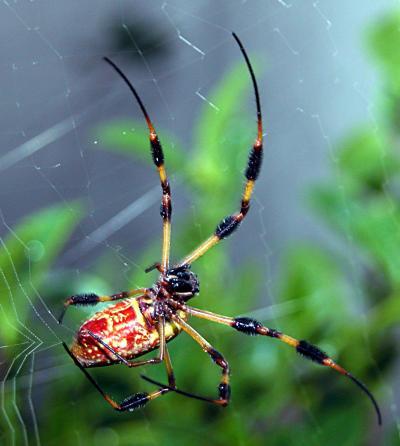
This mature female Golden Silk Spider had just contacted the sticky line with her right leg IV and was about to extend this leg, thereby pulling additional line from her spinnerets.
(Photo Credit: C. Frank StarmerSource: http://commons.wikimedia.org/wiki/File:Oct_03_nephila_weaving.jpg. This file is licensed under the Creative Commons Attribution-Share Alike 2.5 Generic license.)

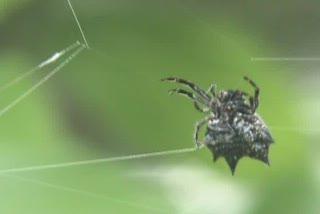
Researchers slow down video images in order to carefully observe how a spider (Gasteracantha) handles the sticky silk that it uses to trap its prey, pulling the silk out of its abdomen with its fourth leg and stretching it to weave its web.
(Photo Credit: Daniel Briceno)