
Loggerhead turtles use visual cues to find gelatinous prey to snack on as they swim in open waters, according to research published June 12 in the open access journal PLOS ONE by Tomoko Narazaki and colleagues from the University of Tokyo, Japan.
Tracking underwater movements with 3D loggers and National Geographic Crittercams, the researchers found the turtles relied on sight, rather than sound or smell, to identify and move toward gelatinous, floating prey like jellyfish and other organisms; one turtle even swam toward a floating plastic bag. Turtles in this study foraged for such foods approximately twice every hour, suggesting they may rely on such gelatinous prey for energy more than previously thought.
Previous studies have shown that turtle diets vary with their age, habitat and other factors, but adult turtles depend on deep-sea hard-shelled animals like mollusks for food. The gelatinous prey studied here are low-energy, easily digestible foods that are unlikely to replace these other prey. However, the authors suggest that opportunistic foraging on such prey may benefit loggerhead turtles during oceanic migrations, when prey at the bottom of the sea is harder to reach.
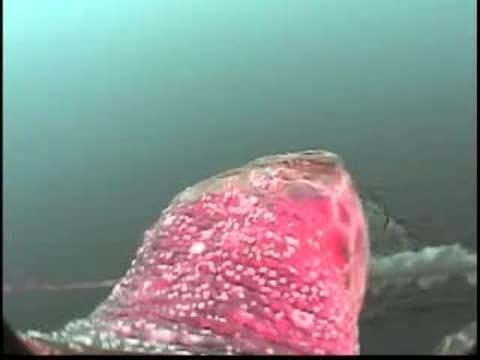
A loggerhead turtle foraged on a sea nettle, Chrysaora melanaster.
(Photo Credit: Narazaki T, Sato K, Abernathy KJ, Marshall GJ, Miyazaki N (2013) Loggerhead Turtles (Caretta caretta) Use Vision to Forage on Gelatinous Prey in Mid-Water. PLOS ONE 8(6): e66043. doi:10.1371/journal.pone.0066043)
The study also offers insights into the foraging habits of these turtles, listed an endangered species by by the International Union for Conservation of Nature (IUCN). The authors add that the methods used here could be developed to map areas with higher foraging opportunities along oceanic migratory routes for loggerhead turtles.
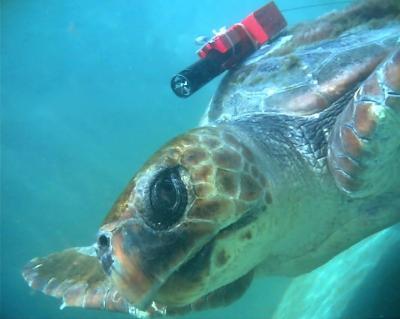
This is a loggerhead turtle in the study equipped with a 3-D logger.
(Photo Credit: Tomoko Narazaki (Atmosphere and Ocean Research Institute, The University of Tokyo))
Citation: Narazaki T, Sato K, Abernathy KJ, Marshall GJ, Miyazaki N (2013) Loggerhead Turtles (Caretta caretta) Use Vision to Forage on Gelatinous Prey in Mid-Water. PLOS ONE 8(6): e66043. doi:10.1371/journal.pone.0066043
Financial Disclosure: This work was supported by the program 'Bio-logging Science', The University of Tokyo (UTBLS), National Geographic Remote Imaging, a JSPS research grant (A1925501 to KS), a JSPS Research Fellowship for Young Scientists to TN (21-7432) and a Sasakawa Scientific Research Grant from The Japan Science Society to TN (19-526). The funders had no role in study design, data collection and analysis, decision to publish, or preparation of the manuscript.
Competing Interest Statement: The authors declare that they received funding from National Geographic Remote Imaging and that two of the authors are employed by National Geographic Remote Imaging. This does not alter the authors' adherence to all the PLOS ONE policies on sharing data and materials.