Earth

Lunar Evolution Gets Some New Light

Light has been shed on the dark parts of the Moon with experiments by University of Edinburgh researchers simulating billions of years of lunar evolution.

It is generally believed the Moon was created after an early, semi molten, Earth collided with a planet the size of Mars.

The collision was so great that the orbiting debris would have formed a so-called lunar magma ocean, or liquefied rock, up to several hundred kilometres deep that would have covered the Moon's surface.

How Greenhouse Gases Saved The World

Sea Level On The Rise, Say Some

The climate system, and in particular sea level, may be responding more quickly to rising carbon emissions than climate scientists have estimated with climate models.

An international team of climate scientists has cautioned against suggestions that the Intergovernmental Panel on Climate Change (IPCC) has previously overestimated the rate of climate change.

How Carbon Dioxide Kept Earth From Being Mars

Carbon dioxide, a greenhouse gas that has become a bane of modern society, may have saved Earth from freezing over early in the planet's history, according to the first detailed laboratory analysis of the world's oldest sedimentary rocks.

Ancient Climate Shifted Wildly

The transition from an ice age to an ice-free planet 300 million years ago was highly unstable, marked by dips and rises in carbon dioxide, extreme swings in climate and drastic effects on tropical vegetation.

"This is the best documented record we have of what happens to the climate system during long-term global warming following an ice age," said Isabel Montañez, professor of geology at the University of California, Davis, and lead author on the paper. But she added that these findings cannot be applied directly to current global warming trends.

Cassini Images Mammoth Cloud Engulfing Titan's North Pole

A giant cloud half the size of the United States has been imaged on Saturn’s moon Titan by the Cassini spacecraft. The cloud may be responsible for the material that fills the lakes discovered last year by Cassini's radar instrument.

Cloaked by winter's shadow, this cloud has now come into view as winter turns to spring. The cloud extends down to 60 degrees north latitude, is roughly 2400 kilometers in diameter and engulfs almost the entire north pole of Titan.

Climate Change Only One Symptom Of A Stressed Planet Earth

A NASA Space Sleuth Hunts the Trail of Earth's Water

Break-up Of Antarctic Ice May Expose Marine Life To More Sunlight And Alter Food Chain

Despite the icy cold and darkness, beneath the frozen surface of the sea in Antarctica thrives a rich and complex array of plants and animals. But what will happen to all those creatures if global warming reduces the ice-cover, as is predicted for coming decades?

Impact Of Rainfall Reaches To Roots Of Mountains

Laser-Assisted Electron Scattering Shows How “Helicity” Impacts Matter and Light

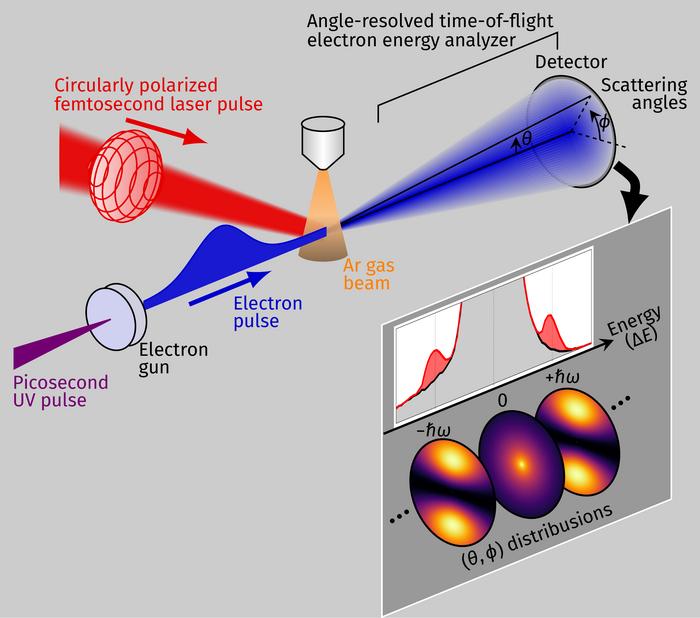
LAES measurement using circularly polarized light. A femtosecond laser pulse and an electron pulse were fired at an argon gas beam at the same time, giving a scattering signal whose energy and angular distributions showed the characteristic peaks of LAES. Credit: Tokyo Metropolitan University


Laser-assisted electron scattering (LAES) is a tool for understanding how electrons interact with matter under the influence of strong fields. When electrons are fired at atoms or molecules, they are scattered in all directions; the presence of strong light can change the way in which the scattering takes place due to an exchange of energy with the surrounding light field. The amount of energy exchanged is precisely governed by quantum mechanics and yields characteristic shifts in the energies held by scattered electrons.

Now, researchers have succeeded in detecting laser-assisted electron scattering using circularly polarized light for the first time. The use of circularly polarized light promises valuable insights into how atomic scale “helicity” impacts how electrons interact with matter and light. Using synchronized femtosecond laser pulses and electron pulses directed at argon atoms, they succeeded in detecting a  laser-assisted electron scattering  signal showing excellent agreement with theory.
 

Recent experiments have used LAES measurements to show how strong electromagnetic fields can fundamentally change the behavior of matter. Examples include “light-dressing,” where strong laser light modifies the distribution of electrons around atoms.

A key challenge in recent work on LAES is the use of circularly polarized light. As a wave of oscillating electric and magnetic fields, light can have a “polarization” direction in which the electric fields oscillate. In circularly polarized light, the polarization direction rotates as the wave propagates forward. Since it has a characteristic “handedness,” of whether it rotates left or right, the way in which it interacts with matter may be sensitive to any intrinsic “chirality” in the structure, the “handedness” of the structure itself. Importantly, measuring the difference between left and right-handed light in LAES gives access to the “phase” of scattered electrons, an inaccessible quantity using linearly polarized light. However, the gold standard measurement of LAES using circularly polarized light in single atoms has not yet been achieved.

The team successfully demonstrated LAES in argon using femtosecond circularly polarized laser pulses in the near-infrared range, and simultaneous electron pulses. They were able to measure the energy and angular distributions of electrons scattered by argon in the presence of femtosecond laser pulses, finding peaks characteristic of the LAES process. While the signal was weaker than with linearly polarized light, the scattering signal agreed with a form expected from seminal extensions to LAES theory (Kroll-Watson theory). At this point, they were unable to measure the minute difference between LAES with left and right-handed light.

While there is further work to be done to improve detection efficiency and statistical accuracy, the team’s work demonstrates how LAES with circularly polarized light might illuminate new aspects of electron-matter interaction in strong fields.


Credit: 
Tokyo Metropolitan University

Glyphosate reduces soil biodiversity and decreases the proportion of native species (French)

C’est l’herbicide le plus utilisé au monde. C’est aussi un mot qui génère, dès qu’il est prononcé, d’intenses passions. Le glyphosate est utilisé en agriculture pour tuer les « mauvaises herbes », et ainsi limiter leurs effets négatifs sur les cultures. Ses effets sur l’homme et l’environnement restent eux sujets à débat dans la communauté scientifique.

Planting trees can help the climate if we also stop burning fossil fuels

A growing number of governments and companies are adopting net-zero greenhouse gas emissions targets. These targets often evoke nature as a way to store or remove carbon from the atmosphere to counter the climate effect of other emissions.

Indaziflam versus invasive species in Yellowstone National Park

Though invasive weeds can devastate native plant communities, a recent study featured in the journal Invasive Plant Science and Management shows that efforts to manage those weeds can also cause harm.

Seagrass and climate change

A common suggestion is to restore natural CO2 reservoirs on the coasts that have been destroyed in many locations during the past decades. This includes mangrove forests, salt marshes and what are known as seagrass meadows. Seagrasses are aquatic plants that thrive in shallow, light-flooded water and are anchored by their roots to the soft seabed. For many animal species, such as manatees that live in tropical waters, seagrass meadows are vital grazing grounds. At the same time, they serve as nurseries all over the world for numerous young fish.