
Since the mTOR pathway can be activated with L-leucine, Xu asked whether leucine would be able to stimulate the sluggish mTOR pathway in RBS cells and ameliorate the associated cellular defects. Remarkably, L-leucine treatment "rescued" some RBS cell defects including protein synthesis and cell growth.
To examine these outcomes in a living animal, Xu then analyzed zebrafish embryos carrying inactived ESCO2. These fish exhibit several properties of human RBS, including underdeveloped cranial features and slow growth. Supplementing L-leucine stimulated the mTOR pathways in RBS zebrafish and resulted in better growth and development.
Gerton is encouraged but cautious about these findings. "Use of a non-toxic, inexpensive amino acid to treat human disease could be of benefit," she says, noting that L-leucine dietary supplementation is being tested in clinical trials for Diamond Blackfan anemia, a genetic disorder. "Leucine supplementation might improve some disease manifestations in RBS, but many aspects of RBS are unlikely to respond to post-natal leucine treatment."
RBS is a rare cohesinopathy, but a related condition called Cornelia de Lange syndrome (CdLS) occurs more frequently—about 1 in 10,000 live births. Researchers have defined mutations causing CdLS, and CdLS zebrafish models are also available. In fact, Gerton recently received a grant from the Cornelia de Lange Syndrome Foundation to assess the effect of L-leucine supplementation in those fish.
Gerton says this work serves as an example of how understanding basic biology can contribute to understanding human disease. "It was only by recognizing the nucleolar defect in baker's yeast that we suspected the involvement of the mTOR pathway and the potential benefit of L-leucine for RBS." The mTOR pathway is also affected in other human diseases, and the effect of L-leucine needs to be tested for those diseases. "Both RBS and CdLS are caused by mutations that affect cohesin, although the molecular basis of CdLS is less well understood," she says. "A logical next step is to determine whether our work on RBS has any relationship to CdLS."
Watch as Stowers Investigator Jennifer Gerton, Ph.D. describes her most recent research discovery.
(Photo Credit: Stowers Institute for Medical Research)
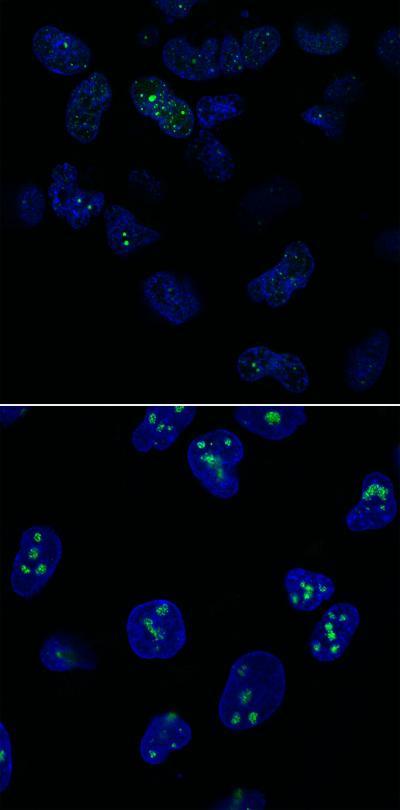
Top: Skin cells from patients with Roberts syndrome display defects in the organization of nucleoli, specialized nuclear subdomains dedicated to the production of ribosomes (shown in green). Bottom: Normal cells. DNA is shown in blue.
(Photo Credit: Image: Courtesy of Dr. Baoshan Xu, Stowers Institute for Medical Research.)