
Both the mature and immature virus shells are honeycomb-like lattices of hexagon-shaped units. Using a combination of electron microscopy and computer-based methods, Briggs and colleagues investigated which parts of the key proteins stick together to build the honeycomb of the immature shell. These turned out to be very different from the parts that build the mature shell. This knowledge will help scientists to unravel how the immature virus is assembled in the cell and how the shell proteins rearrange themselves to go from one form to the other.
Findings such as these may one day prove valuable to those wanting to design new types of anti-retroviral therapies. Many anti-retroviral drugs already block the enzyme that would normally separate components of the immature shell to allow it to mature. But there are currently no approved drugs that act on that shell itself and prevent the enzyme from locking on.

As a retrovirus matures, the two parts of its shell protein (red and blue or yellow and blue) dramatically rearrange themselves, twisting and moving away from each other.
(Photo Credit: EMBL/T.Bharat)
Although the virus shells imaged in this study were derived from the Mason-Pfizer monkey virus and made artificially in the laboratory, they closely resemble those of both this virus and HIV – which are very similar – in their natural forms.
"We still need a lot more detailed information before drug design can really be contemplated," Briggs concludes, "but finally being able to compare mature and immature structures is a step forwards."
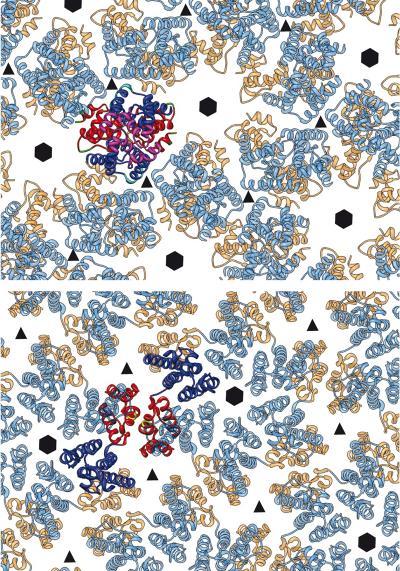
As a retrovirus matures, the two parts of its shell protein (red and blue or yellow and blue) dramatically rearrange themselves, twisting and moving away from each other.
(Photo Credit: EMBL/T.Bharat)

The role and shape of the protein shell (blue/orange) changes from the immature (top) to the mature form of the virus (bottom).
(Photo Credit: EMBL/T.Bharat)