
Ryan compared the phenomenon to what's called a "continuity illusion" in humans. If loud enough white noise is played in between a pair of beeps, humans will begin to perceive the beeps as a continuous tone. It's not fully understood why this happens, but it's probably a byproduct of our brains' useful ability to filter out background noise.
Túngara frogs are challenged by an auditory world similar to what confronts humans in noisy environments (what's called the "cocktail party problem" by cognitive scientists). At breeding choruses there is a lot of noise and cross talk, with sounds and images of several males reaching the female at different times. The females need to extract meaningful information from all of that. Ryan said it's plausible the neural mechanisms that enable them to correctly parse these stimuli in nature are being hijacked by this artificial scenario.
"We need to be able to hook things together perceptually in unexpected ways to extract meaningful stimuli from a lot of noise," said Ryan. "So what we think is happening here is that the vocal sac, the visual cue, is working kind of like the white noise, giving perceptual continuity between these two sounds, binding the temporally displaced whine and chuck together."
Ryan said that although the frogs' aggressive search for meaning leaves them open to being tricked by clever researchers, it could also enable more flexibility in complex situations. He believes it may have a much longer-term evolutionary advantage as well.
"It's an example of how complex traits could emerge from simpler ones," he said. "In this case there's no obvious advantage to these two behaviors being hooked together in this way, but think of how you can take a muscle and move its insertion on the bone and have a great influence on speed. You didn't get the evolution for these bones and muscles all at the same time, but just by making a change or adding a muscle, now you change the functional coupling. You end up with something really complex, but it evolved in a really simple way. I think in this case we may be seeing an example of how that could happen."
R.C. Taylor is an associate professor of biology at Salisbury University in Maryland.

When choosing a potential mate, female túngara frogs listen to the sounds of the male calls, which are based on a pattern of "whines" and "chucks." If visible, the sight of the male frogs inflating their vocal sacs adds to the appeal of the calls. In this video a female tungara frog approaches a robofrog inflating its vocal sac. The female can also hear recorded mating calls playing.
(Photo Credit: Michael Ryan, University of Texas at Austin)
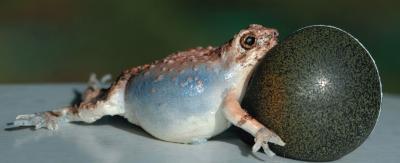
In an innovative experiment, biologists Michael Ryan and Ryan Taylor used recordings of male tungara frog mating calls, along with a robotic frog that can inflate its vocal sac, to investigate how visual and auditory signals can combine to attract females.
(Photo Credit: Michael Ryan, University of Texas at Austin)
Source: University of Texas at Austin