
"Using a combination of theory and experiments, we uncovered design principles for optimum nets which self-assemble with high yields," said David Gracias, associate professor in of chemical and biomolecular engineering at Johns Hopkins and a co-corresponding author on the paper. "In doing so, we uncovered striking geometric analogies between natural assembly of proteins and viruses and these polyhedra, which could provide insight into naturally occurring self-assembling processes and is a step toward the development of self-assembly as a viable manufacturing paradigm."
"This is about creating basic tools in nanotechnology," said Menon, co-corresponding author on the paper. "It's important to explore what shapes you can build. The bigger your toolbox, the better off you are."
While the approach has been used elsewhere to create smaller particles at the nanoscale, the researchers at Brown and Johns Hopkins used larger sizes to better understand the principles that govern self-folding polyhedra.
The researchers sought to figure out how to self-assemble structures that resemble the protein shells viruses use to protect their genetic material. As it turns out, the shells used by many viruses are shaped like dodecahedra (a simplified version of a geodesic dome like the Epcot Center at Disney World). But even a dodecahedron can be cut into 43,380 planar nets. The trick is to find the nets that yield the best self-assembly. Menon, with the help of Brown undergraduate students Margaret Ewing and Andrew "Drew" Kunas, sought to winnow the possibilities. The group built models and developed a computer code to seek out the optimal nets, finding just six that seemed to fit the algorithmic bill.
The students got acquainted with their assignment by playing with a set of children's toys in various geometric shapes. They progressed quickly into more serious analysis. "We started randomly generating nets, trying to get all of them. It was like going fishing in a lake and trying to count all the species of fish," said Kunas, whose concentration is in applied mathematics. After tabulating the nets and establishing metrics for the most successful folding maneuvers, "we got lists of nets with the best radius of gyration and vertex connections, discovering which nets would be the best for production for the icosahedron, dodecahedron, and truncated octahedron for the first time."
Gracias and colleagues at Johns Hopkins, who have been working with self-assembling structures for years, tested the configurations from the Brown researchers. The nets are nickel plates with hinges that have been soldered together in various 2-D arrangements. Using the options presented by the Brown researchers, the Johns Hopkins's group heated the nets to around 360 degrees Fahrenheit, the point at which surface tension between the solder and the nickel plate causes the hinges to fold upward, rotate and eventually form a polyhedron. "Quite remarkably, just on heating, these planar nets fold up and seal themselves into these complex 3-D geometries with specific fold angles," Gracias said.
"What's amazing is we have no control over the sequence of folds, but it still works," Menon added.
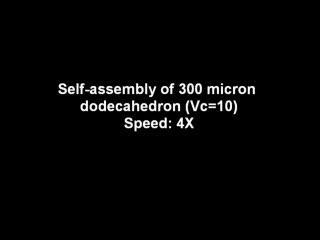
Researchers at Brown and Johns Hopkins universities have found optimal configurations for creating 3-D geometric shapes. The research may lead to advances from drug-delivery containers to 3-D sensors and electronic circuits.
(Photo Credit: Shivendra Pandey/Gracias Lab, Johns Hopkins University)
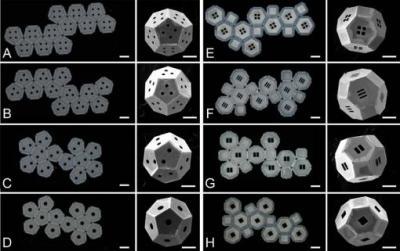
This showas a few of the 2.3 million possible 2-D designs -- planar nets -- for a truncated octahedron (right column). The question is: Which net is best to make a self-assembling shape at the nanoscale?
(Photo Credit: : Shivendra Pandey/Gracias Lab, Johns Hopkins University)
Source: Brown University