
Bergman has now analyzed recordings of the geladas' vocalizations, known as "wobbles," to find a rhythm that closely matches human speech. In other words, because they vocalize while lip-smacking, the pattern of sound produced is structurally similar to human speech.
In both lip-smacking and speech, the rhythm corresponds to the opening and closing of parts of the mouth. What's more, Bergman said, lip-smacking might serve the same purpose as language in many basic human interactions—think of how friends bond through small talk.
"Language is not just a great tool for exchanging information; it has a social function," Bergman said. "Many verbal exchanges appear to serve a function similar to lip-smacking."
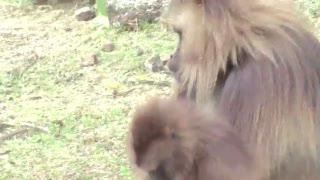
The vocal lip-smacks that geladas use in friendly encounters have surprising similarities to human speech, according to a study reported in the Cell Press journal Current Biology on April 8th. The geladas, which live only in the remote mountains of Ethiopia, are the only nonhuman primate known to communicate with such a speech-like, undulating rhythm. Calls of other monkeys and apes are typically one or two syllables and lack those rapid fluctuations in pitch and volume.
(Photo Credit: Current Biology, Bergman)
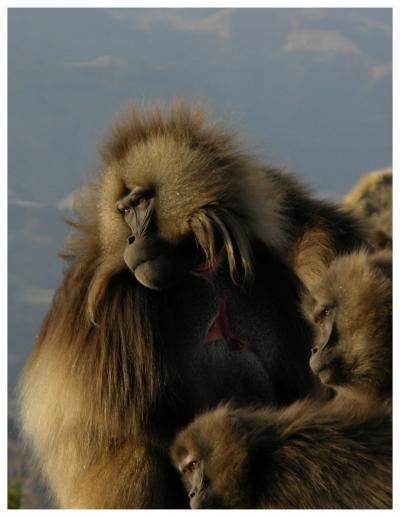
The vocal lip-smacks that geladas use in friendly encounters have surprising similarities to human speech, according to a study reported in the Cell Press journal Current Biology on April 8th. The geladas, which live only in the remote mountains of Ethiopia, are the only nonhuman primate known to communicate with such a speech-like, undulating rhythm. Calls of other monkeys and apes are typically one or two syllables and lack those rapid fluctuations in pitch and volume.
(Photo Credit: Current Biology, Bergman)
Source: Cell Press