
In a parallel experiment, the scientists asked blindfolded people to perform the same action, positioning palm nuts on an anvil as if to crack them with a stone or hammer. Like the monkeys, the human participants also followed tactile cues to place the nut flat-side down on the anvil.
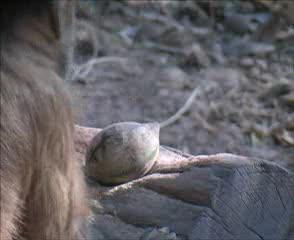
This video shows two episodes in which a bearded capuchin monkey places and strikes a nut with the Stop meridian marked with a black line or a black-hatched line, and the Roll meridian marked with a red or green line.
(Photo Credit: Fragaszy DM, Liu Q, Wright BW, Allen A, Brown CW, et al. (2013) Wild Bearded Capuchin Monkeys (Sapajus libidinosus) Strategically Place Nuts in a Stable Position during Nut-Cracking. PLoS ONE 8(2): e56182. doi:10.1371/journal.pone.0056182)
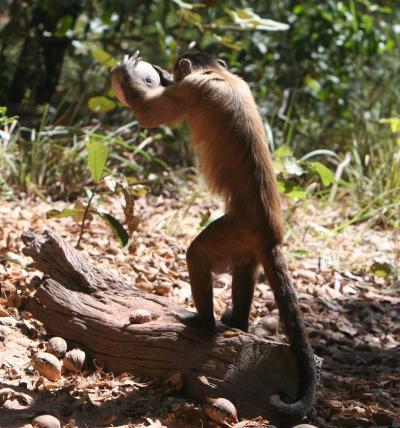
A bearded capuchin monkey cracks open a stably-placed palm nut with a stone for a hammer.
(Photo Credit: Barth Wright)
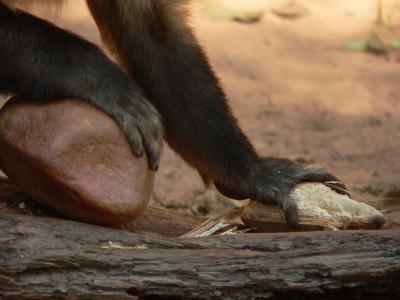
Bearded capuchin monkeys deliberately place palm nuts in a stable position on a surface before trying to crack them open, revealing their capacity to use tactile information to improve tool use.
(Photo Credit: Barth Wright)
Source: Public Library of Science