
"If you imagine stretching Silly Putty or a swimming cap with a picture on it, as you pull, the picture becomes distorted," Boyle said. "This allows us to track how the material responds to an external force."
In one of the experiments described in the paper, Boyle sprayed a pattern of dots on plastic wrap, stretched it and tracked the dots.
"As you pull and stretch the plastic wrap, eventually tears begin to emerge," he explained. "The new algorithm allowed us to find the places where the tears were beginning to form and to track them as they extended. Older algorithms are not as good at finding and tracking localized strains as the material stretches."
In fact, one of the two new algorithms is 1,000 times more accurate than older methods at quantifying very large stretches near tiny cracks and tears, the research showed. And a second algorithm has the ability to predict where cracks and failures are likely to form.
"This extra accuracy is critical for quantifying large strains," said Guy Genin, PhD, professor of mechanical engineering and co-senior investigator on the study. "Commercial algorithms that estimate strain often are much less sensitive, and they are prone to detecting noise that can arise from the algorithm itself rather than from the material being examined. The new algorithms can distinguish the noise from true regions of large strains."
Thomopoulos, who also is a professor of biomedical engineering and of mechanical engineering, works with Genin to study the shoulder's rotator cuff, a group of tendons and muscles that connect the upper arm to the shoulder blade. They want to learn why some surgeries to repair rotator cuff injuries ultimately fail. Their goal is to increase the odds that the tissue in the shoulder will heal following surgery, and they believe the new algorithms could help them get closer to that goal.
How soon the new algorithms could be used in patients depends on getting better images of the body's tissues. Current imaging techniques, such as MRI and ultrasound, lack the required clarity and resolution.
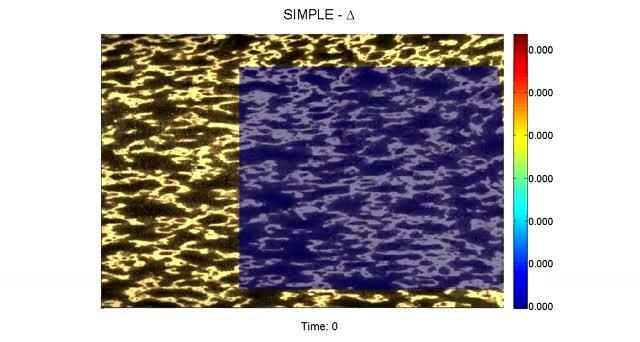
As a piece of plastic wrap is stretched, the new algorithms identify the location (in red) where it is weakening, which is where the material eventually breaks.
(Photo Credit: John Boyle, © The Royal Society (used with permission))
Genin also explained that although the goal of the current study is to better understand how forces at work on human tissue cause injury and stress, the algorithms also could help engineers identify vulnerable parts of buildings and other structures. Our muscles and bones, he said, are influenced by the same strains that affect those structures.
"Whether it's a bridge or a tendon, it's vital to understand the ways that physical forces cause structures and tissues to deform so that we can identify the onset of failures and eventually predict them," he said.
In the long run, they want to use the algorithms to prevent additional injuries following surgery to repair knees, shoulders and other tissues. They also said it may be possible some day to predict problems before they occur.
The group, which applied for a provisional patent earlier this year, hopes the algorithms will be useful to researchers in the medical and engineering fields.
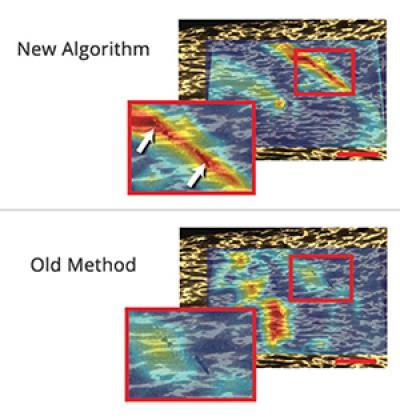
The top image shows how the new algorithm is able to identify an area (in red) where stress has created a weak spot in a small piece of plastic wrap. The older method (shown in the bottom half of the picture) is unable to pinpoint the place where the plastic wrap is weakening.
(Photo Credit: John Boyle, © The Royal Society (used with permission))
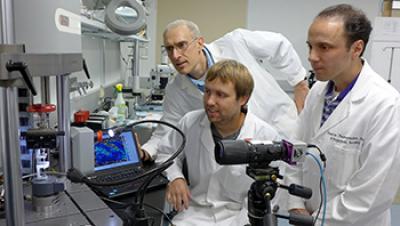
From left, Guy Genin, Ph.D., John Boyle and Stavros Thomopoulos, Ph.D., watch as a sample is exposed to stress and force. They have developed algorithms that may lead to the ability to identify weak spots in tendons, muscles and bones.
(Photo Credit: Robert Boston)