
Approximately half of the world's population is at risk of contracting malaria each year, with more than 200 million people infected. Malaria kills up to 700,000 people each year, predominantly children under the age of five. Current antimalarial drugs are becoming less effective as the parasite develops resistance to the drugs, making the search for new targets that can kill all species of malaria critical.
Institute scientists will now turn their attention to developing WEHI-916 and related compounds for human use, Dr Boddey said. "We are now examining in our insectary whether Plasmepsin V could be a target during other stages of the malaria lifecycle," Dr Boddey said. "The enzyme is present in the parasites that first infect humans in the liver, as well as in parasite forms that exit humans and infect mosquitoes. If WEHI-916 kills the parasite during these stages as well, it will mean any drugs that target Plasmepsin V can be used as a preventative as well as a cure."
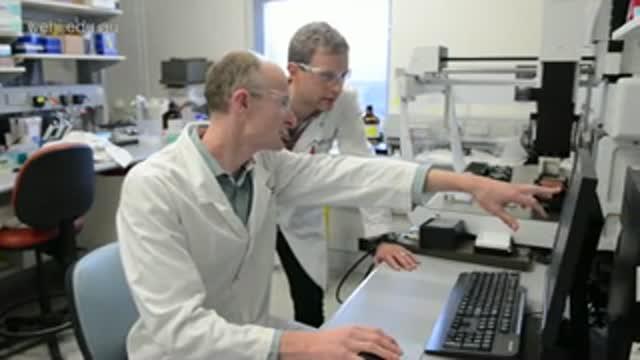
Melbourne researchers are homing in on a new target for malaria treatment, after developing a compound that blocks the action of a key 'gatekeeper' enzyme essential for malaria parasite survival.
The compound, called WEHI-916, is the first step toward a new class of antimalarial drugs that could cure and prevent malaria infections caused by all species of the parasite, including those resistant to existing drugs.
Read more: http://www.wehi.edu.au/site/latest_news/new_compound_blocks_gatekeeper_e...
(Photo Credit: Walter and Eliza Hall Institute)
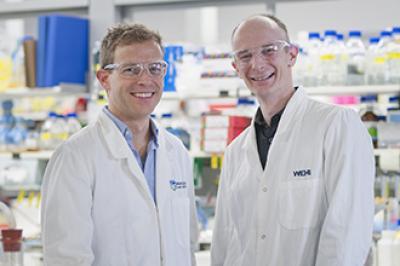
Dr Justin Boddey (L), Dr Brad Sleebs and colleagues have developed a compound that blocks the action of a key 'gatekeeper' enzyme essential for malaria parasite survival.
(Photo Credit: Walter and Eliza Hall Institute)
Source: Walter and Eliza Hall Institute