
Wild male orangutans plan their travel and communicate their plans to other orangutans, according to research published September 11 in the open access journal PLOS ONE by Carel van Schaik and colleagues from the Anthropological Institute and Musuem in Zurich, Switzerland.
Although previous studies have shown that great apes can plan for future needs, it has not been clear whether and how they do so in the wild. In this study, authors studied the calls of orangutans that live in dense tropical forests, often out of sight from others in their population. Adult males emit loud, long vocalizations audible over a kilometer away to establish their status amongst other males or signal to females. Tracking over 200 calls made by 15 adult males in the wild, the researchers found that males faced the direction they planned to travel and emitted 'long calls' in that direction the night before a journey. If they changed travel plans the following morning, males were more likely to follow up with a call in the new direction planned. Co-author Karin Isler expands, "We found that males emitted long calls mostly facing the direction they travelled a few hours later, or even after a night's rest."
Females within earshot frequently followed the path taken by the male and changed direction when the male did. Subordinate males who heard these calls tended to avoid following a similar path.
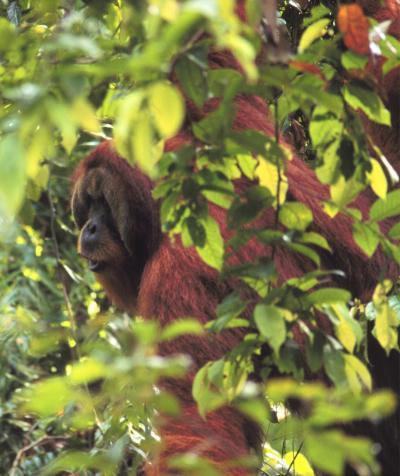
Male orangutans face the direction they plan to travel and emit 'long calls' in that direction.
(Photo Credit: Carel van Schaik)
When orangutans choose to plan their trips in advance is not yet clear; some of the reasons suggested include avoidance of a known rival, searching for mates or food. The researchers add that such planning abilities may not be limited to orangutans, and may exist in other apes or large-brained animals.
Source: Public Library of Science