
Intriguingly, the new fossil shows that baby Parasaurolophus had a low bump on top of its head, which only later morphed into the curved tube of adults. "Our baby Parasaurolophus is barely one-quarter of adult size, but it had already started growing its crest," stated lead project scientist Andrew Farke, who is Augustyn Family Curator at the Raymond M. Alf Museum of Paleontology. "This is surprising, because related dinosaurs didn't sprout their ornamentation until they were at least half-grown. Parasaurolophus had to get an early start in order to form its unique headgear."
A sample of bone from the leg helped estimate the animal's age at death. "Dinosaurs have yearly growth rings in their bone tissue, like trees. But we didn't see even one ring. That means it grew to a quarter of adult size in less than a year," commented co-author Sarah Werning of Stony Brook University. Although "Joe" was only six feet long and a year old, it would have grown to 25 feet in length as an adult.
The fossil skeleton has yielded a world of previously unknown information about Parasaurolophus and its relatives. Medical scans documented the internal anatomy of the animal's skull, allowing a reconstruction of its vocal capabilities. "If adult Parasaurolophus had 'woofers,' the babies had 'tweeters.' The short and small crest of baby 'Joe' shows that it may have had a much higher pitch to its call than did adults," stated Andrew Farke. "Along with the visual differences, this might have helped animals living in the same area to figure out who was the big boss."
Because of the broad importance of the fossil, researchers have made 3D digital scans of the entire fossil freely available on-line (links via http://www.dinosaurjoe.com). Although portions of other dinosaur fossils have been scanned and distributed in this way before, this the first time that virtually an entire skeleton has been posted. This will allow scientists and the public alike unparalleled access to this fossil.
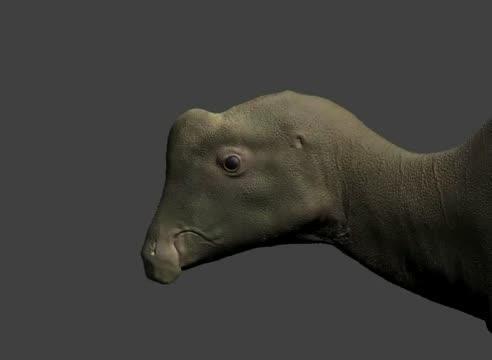
This video contains an artist's rendition of the baby Parasaurolophus nicknamed "Joe."
(Photo Credit: Tyler Keillor)
The study describing the new fossil was published today in the open access scientific journal PeerJ (meaning that anyone can read and download the article for free, and without restrictions). Additionally, the specimen is now on exhibit at the Raymond M. Alf Museum of Paleontology in Claremont, California. Researchers who co-authored the study include Andrew Farke (Raymond M. Alf Museum of Paleontology, Claremont, California), Sarah Werning (University of California Museum of Paleontology, Berkeley, and Stony Brook University, New York), and high school students Derek Chok, Annisa Herrero, and Brandon Scolieri (The Webb Schools, Claremont, California). The fossil was collected under a permit from Grand Staircase-Escalante National Monument and the Bureau of Land Management, Utah.
DISCOVERY BRIEF:
- The fossil, nicknamed "Joe", was found by a high school student in Grand Staircase-Escalante National Monument in southern Utah.
- "Joe" is a baby Parasaurolophus, the most complete skeleton yet known from this herbivorous tube-crested dinosaur that lived 75 million years ago.
- "Joe" was less than six feet long and under a year old when it died, and would have grown to an adult measuring nearly 25 feet long.
- "Joe" shows that Parasaurolophus formed its unusual headgear by expanding some of its skull bones earlier and for a longer period of time than its close relatives.
- The skeleton of "Joe" is the most complete digitally-accessible dinosaur to date, with 3D models and scans of virtually every aspect of its anatomy freely available for download.
- High school students were involved in the collection, study, and publication of this rare find, through the Raymond M. Alf Museum of Paleontology at The Webb Schools in Claremont, California.

This is the skeleton of the baby Parasaurolophus nicknamed "Joe."
(Photo Credit: Raymond M. Alf Museum of Paleontology)

This image shows a comparison of the size of the baby Parasaurolophus (green) to adult Parasaurolophus, as well as an adult and baby human.
(Photo Credit: Scott Hartman, Matt Martyniuk, and Raymond M. Alf Museum of Paleontology)