
In Lee's study of cottonseeds, done in partnership with a team of U.S. and German scientists, the technique showed a distribution of lipids that varies with tissue function. The knowledge could yield useful information about cottonseed, a crop valued as a possible source of biofuel and for its oil in the food industry.
"This information is really so new to scientists that we don't know yet what it means. As a matter of fact, it challenges plant biologists at the moment to take hold of that data and integrate it into the way they do their science," said Nikolau. "This data will change the future of how we do research."
Lee said that though there was still much to learn about developing procedures using MALDI-MS to detect the tiny amounts of material in cells, he expects the use of the technique in plant science to gain wider use.
"Up until this point, this method has not really been recognized by plant scientists. But we were able to bring the technologies of analytical chemistry to the biological science problem of being able to map molecules at the single cell level. There is still a lot to learn about the process, but this technique is going to blossom very rapidly in the next few years."
Nikolau believes the technology will be a key to thoroughly understanding plant biosynthesis, and in turn alternative energy production.
"This is really about the sustainability of our chemical world," he said. "When you're talking about chemical energy, you're talking about carbon. Historically, over the last 100 years, it's been carbon from petroleum. If you're going to make biorenewable chemicals, the carbon comes in through photosynthesis, through plants. That process happens in discrete compartments within the organism, within individual cells. Science needs to know that highly detailed spatial information to take full advantage of it."
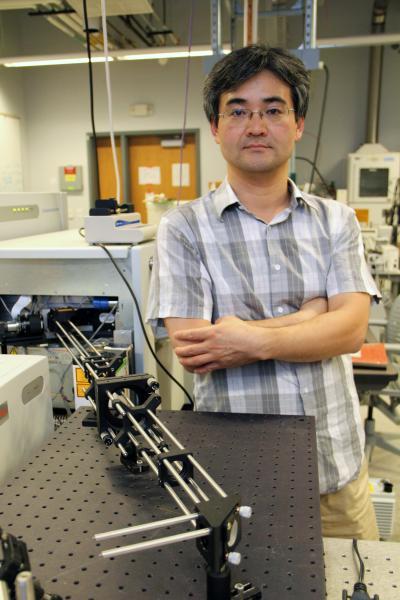
Young-Jin Lee, a scientist at the US Department of Energy's Ames Laboratory, has successfully demonstrated the use ofmatrix-assisted laser deposition/ionization-mass spectrometry to map the distribution of metabolites in plant tissues.
(Photo Credit: DOE's Ames Laboratory)
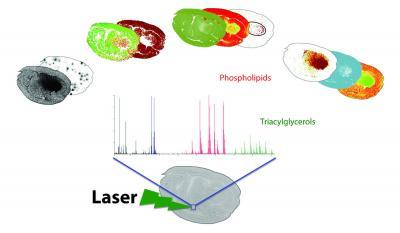
Matrix-assisted laser deposition/ionization-mass spectrometry, or MALDI-MS, maps the distribution of lipids in a cottonseed in a recentpaper published in The Plant Cell, a premier research publication inplant science. The Ames Laboratory's team of researchers has developeda highly sensitive mass spectrometry technique to investigate metabolites, the small molecules that are the building blocks for plant biological processes.
(Photo Credit: DOE's Ames Laboratory)
Source: DOE/Ames Laboratory