
Working with Yalei Chen, graduate student in cell and developmental biology in the Huck Institutes of the Life Sciences, the researchers found that kinesin motors can not only transport molecules along the tubules, but can redirect the ends of the tubules to enter the proper branch of the dendrite. They report their findings online today (Jan. 23) in Current Biology.
In the laboratory, the researchers grew microtubules under the microscope and used protein engineering to attach a kinesin motor to EB1 -- a protein that binds to the growing end of microtubules.
"One of the reasons we thought the model might not work is that the molecule EB1 grabs the plus end of the microtubule very loosely," said Rolls. "We were unsure how something so dynamic could hold the forces, but it does."
The researchers found that it is a form of crowd sourcing -- while one molecule is only loosely bound and releases quickly, the microtubule's plus end is surrounded by hundreds of these molecules so the EB1 can guide the motor protein where to go. The kinesin motor walks along a stationary microtubule until it enters the branch.
In the laboratory, the combination EB1 and kinesin motor moved the microtubule ends far enough for redirection into branches.
The researchers state that "EB1 kinetics and mechanics are sufficient to bend microtubules for several seconds." They also suggest that "other kinesins also demonstrate this activity, suggesting this is a general mechanism for organizing and maintaining proper microtubule polarity in cells."
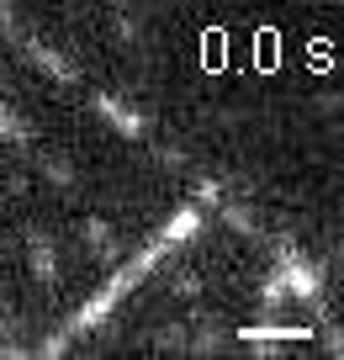
This is a movie of a polymerizing microtubule (originating in bottom left corner) encountering a static microtubule in middle of screen. During the encounter the polymerizing microtubule is bent by a fluorescently-labeled complex of end-binding protein 1 (EB1) and a kinesin motor. After being bent, the microtubule eventually snaps back to its original position and the EB1-kinesin complex continues to walk along the static microtubule. Time (in seconds) is shown at top right and scale bar is 1 micron.
(Photo Credit: William Hancock, Penn State)

This is a model for maintenance of proper microtubule polarity in dendrites. Polymerizing microtubules entering junctions encounter existing static filaments. A complex consisting of end-binding protein 1 (EB1) and a kinesin molecular motor binds to the tip of the growing filament and moves along the static filament to co-align the filaments and maintain proper uniform orientation. The present work demonstrates that an EB1-kinesin complex is able to steer a growing microtubule in this manner without the requirement for any other cellular components.
(Photo Credit: William Hancock, Penn State)
Source: Penn State