
In the debate over alternative energy resources, geothermal technology has received scant media attention. Advocates call it one of the cleanest, sustainable energy resources available. However, steep construction, equipment and drilling costs have prevented more widespread development of geothermal technology. An Ohio University hydrothermal systems expert is working to change that.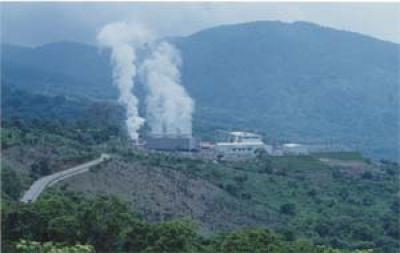 Geothermal power plants harness energy created by heat at the Earth's core. Credit: Dina Lopez/Ohio University
Earth
Researchers at the Smithsonian Environmental Research Center report the results of a six-year experiment in which doubling the atmospheric greenhouse gas carbon dioxide (CO2) in a scrub oak ecosystem caused a reduction in carbon storage in the soil.
The scientists said this response suggests a limited capacity of Earth’s ecosystems to stabilize atmospheric CO2 and slow global warming. These findings add a new perspective and a measure of caution suggesting that elevated CO2, by altering microbial communities, may turn a potential carbon sink into a carbon source.
Plant and animal diseases can play a major and poorly appreciated role in allowing the invasion of exotic species, which in turn often threatens biodiversity, ecological function and the world economy, researchers say in a new report.
Assigning dates to the events in the life of a rock—for example, a collision with a piece of continent, or a journey through the Earth’s crust—has long challenged geologists, as the events themselves can confound evidence of the past.
Severe climate changes during the last ice-age could have been caused by random chaotic variations on Earth and not governed by external periodic influences from the Sun. This has been shown in new calculations by a researcher at the Niels Bohr Institute, Copenhagen University.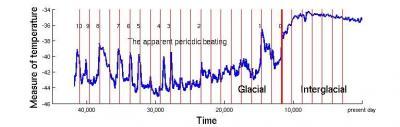 The temperature curve through the Greenland inland ice sheet shows 26 dramatic and abrupt climate shifts during the last ice age that lasted more than 100.000 years. This curve shows the climate shifts during 40,000 years.
A new understanding of how plants manage their internal calcium levels could potentially lead to genetically engineering plants to avoid damage from acid rain, which robs soil of much of its calcium.
"Our findings should help scientists understand how plant ecosystems respond to soil calcium depletion and design appropriate strategies to protect the environment," said Zhen-Ming Pei, a Duke University assistant professor of biology who led the study, to be published in the Friday, March 9, issue of the journal Science.
Like a piece of chalk dissolving in vinegar, marine life with hard shells is in danger of being dissolved by increasing acidity in the oceans.
Ocean acidity is rising as sea water absorbs more carbon dioxide released into the atmosphere from power plants and automobiles. The higher acidity threatens marine life, including corals and shellfish, which may become extinct later this century from the chemical effects of carbon dioxide, even if the planet warms less than expected.
The buildup of greenhouse gases in Earth’s atmosphere and oceans continues to provoke changes in the natural environment that scientists have been working to measure for decades. Global increases in temperature are just one facet of a much larger issue that scientists at the Rosenstiel School of Marine and Atmospheric Science are dedicated to uncovering.
"The Sopranos" have some competition -- brown-headed cowbirds.
Cowbirds have long been known to lay eggs in the nests of other birds, which then raise the cowbirds’ young as their own.
Sneaky, perhaps, but not Scarface.
Now, however, a University of Florida study finds that cowbirds actually ransack and destroy the nests of warblers that don’t buy into the ruse and raise their young.
Researchers at Rensselaer Polytechnic Institute have discovered what likely triggered the eruption of a "supervolcano" that coated much of the western half of the United States with ash fallout 760,000 years ago.
It's essential to all life, and numerous research papers are published about it every year. Yet there are still secrets to reveal about water, that seemingly simple compound we know as H2O.
The chemical bond between carbon and fluorine is one of the strongest in nature, and has been both a blessing and a curse in the complex history of fluorocarbons.
 The changing Larsen-B Ice Shelf captured by Envisat on 22 February 2007 with its Advanced Synthetic Aperture Radar (ASAR). The Larsen Ice Shelf is a series of three shelves – A (the smallest), B and C (the largest) – that extend from north to south along the eastern side of the Antarctic Peninsula. Changes in ice shelves are believed to be indicators of climate change, as evidence suggests high latitudes experience the greatest atmospheric warming.
The French Intergovernmental Panel on Climate Change (IPPC, or GIEC in French) has just announced the conclusions of its 4th report, which restates that global warming has increased the average temperature by 0.74°C over the last century. However, there is very little information about some parts of the planet, such as central Asia.
A wedge of sediment, pushed up by glacial movement, may be a buffer against moderate sea level rise, pointing to ocean temperature rise as the key factor in glacial retreat, according to two papers published today (March 1) in Science Express.