
In their study, Noel and his collaborators identified three promising genes through analysis of plant genomic data, and then used a variety of techniques, including protein x-ray crystallography, computational biology, biochemistry, mutant plant analysis, metabolomics and gene expression profiling, to functionally characterize the proteins these genes produce.
They found that the proteins, FAP1, FAP2 and FAP3, bind fatty acids, including the major plant omega-3 fatty acid, an important nutritional component found in certain seeds. "They say a picture is worth a thousand words, and that is certainly the case for these FAPs," says Gordon Louie, an HHMI researcher in Noel's laboratory, who determined the three-dimensional arrangement of the FAPs holding on to their fatty acid cargo.
The proteins were found in the chloroplasts, the site of fatty acid production and photosynthesis. This suggested that these proteins play a role in the metabolism of fatty acids and thus in the production of fatty acids for plant membranes and oils.
This hypothesis was reinforced by showing that the FAP genes are most active in developing seeds, appearing at the same time and location as well-known enzymes involved in fatty acid synthesis. The researchers also found that altering the expression of these genes in a plant leads to changes in the quality and amounts of fatty acids.
"The proteins appear to be crucial missing links in the metabolism of fatty acids in Arabidopsis, and likely serve a similar function in other plant species since we find the same genes spread throughout the plant kingdom," says Ryan Philippe, a postdoctoral researcher in Noel's lab.
Micheline Ngaki, a graduate student in Wurtele's lab, says that if the researchers can understand precisely what role the proteins play in seed oil production, they might be able to modify the proteins' activity in new plant strains to produce more oil or higher quality oil than current crops.
The researchers' findings also have implications for evolutionary biology and how large and essential families of enzymes arise from nonenzymatic cousins and are then perfected by evolution.
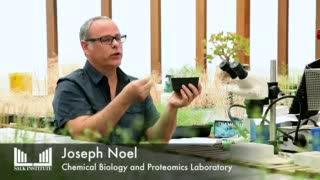
Scientists at the Salk Institute for Biological Studies and Iowa State University discovered a family of plant proteins that play a role in the production of seed oils, substances important for animal and human nutrition, biorenewable chemicals and biofuels.
(Photo Credit: Courtesy of the Salk Institute for Biological Studies)
The ancient ancestors of the proteins the research teams discovered evolved into the enzyme chalcone isomerase, which plays a key role in the production of a group of polyphenols known as flavonoids, compounds that serve a number of functions in plants and are critical for disease prevention in human diets.
"One function of flavonoids is to protect plants from sunlight, which would have been key when plants first emerged from the oceans and lakes to colonize land," says Noel. "We've shown that the very ancient FAP proteins still found in algae and other non-plant organisms acquired chalcone isomerase activity hundreds of millions of years ago, allowing land plants to produce flavonoids for survival in the absence of the protective environment of water."
The discovery may also help bioengineers focused on creating new enzymes for industrial uses by revealing how nature evolves proteins into chemical machines known as enzymes.
"Nature has been perfecting enzymes for at least three billion years because they carry out the hundreds of thousands of chemical reactions in all organisms, and these reactions are needed by us all to survive and prosper," says Noel. "We could learn a lot by understanding that three-billion year old experiment."
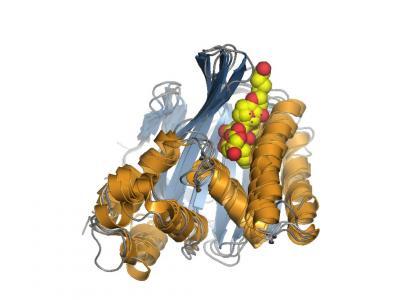
Overlay of the known structures of CHI-fold proteins from Arabidopsis thaliana and alfalfa (Medicago sativa). Protein backbones are shown as ribbons, with β-strands depicted as flat arrows (blue), α-helices as broad coils (orange), and loops as thin rope (gray). The various bound ligands in these proteins (naringenin in alfalfa CHI, and fatty acids in AtFAP1 and AtFAP3) are shown as van der Waals spheres.
(Photo Credit: Courtesy of the Salk Institute for Biological Studies)
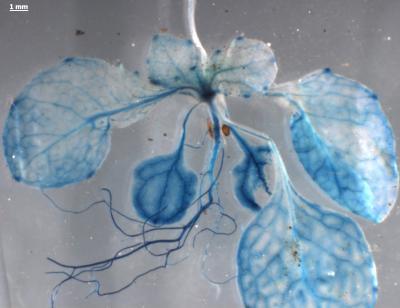
The researchers identified three proteins involved in seed oil production in thale cress plants. This thale cress seedling is shown producing one of the proteins, evidenced by the blue stain on its stems and leaves.
(Photo Credit: Courtesy of Eve Syrkin Wurtele, Iowa State)
Source: Salk Institute