
Turns out they were right.
Cha, a graduate student in cell and molecular biology at the university, searched for a molecule that would inhibit the action of those yeast genes. She found that thiabendazole did the trick.
She then tested the drug in developing frog embryos. These are fast growing vertebrates in which scientists can watch blood vessel growth in living animals.
Cha found that frog embryos grown in water with the drug either didn't grow blood vessels or grew blood vessels that were then dissolved away by the drug. Interestingly, when the drug was removed, the embryos' blood vessels grew back.
Cha then tested the drug on human blood vessel cells growing in Petri dishes, finding that the drug also inhibited their growth. Finally, she tested the drug on fibrosarcoma tumors in mice and found that it reduced blood vessel growth in the tumors as well as slowed the tumors' growth.
"We didn't set out to find a vascular disrupting agent, but that's where we ended up," said Wallingford, associate professor of developmental biology and Cha's graduate advisor with Marcotte. "This is an exciting example of the power of curiosity-driven research and the insights that can come from blending disciplines in biology."
The scientists' goal is now to move the drug into clinical trials with humans. They are talking with clinical oncologists about next steps.
"We hope the clinical trials will be easier because it is already approved by the FDA for human use," said Marcotte.
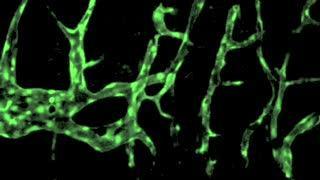
Blood vessel development in tadpoles with and without the common antifungal drug thiabendazole shows how the drug is a "vascular disrupting agent."
(Photo Credit: Hye Ji Cha, The University of Texas at Austin)
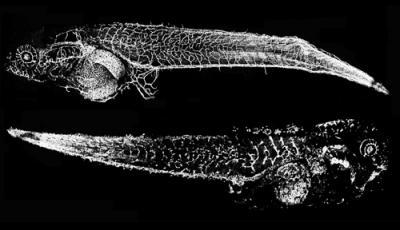
This image shows a frog tadpole with normal blood vessel development (fluorescing, top) and a frog tadpole with blood vessel development that was disrupted by the common antifungal medication, thiabendazole (bottom). New research published by Cha et. al. reveals that thiabendazole slows tumor growth and shows promise as a chemotherapy for cancer.
(Photo Credit: Hye Ji Cha, The University of Texas at Austin)
Source: University of Texas at Austin