
The results of Chen's research were published online in the journal Proceedings of the National Academy of Sciences. Katrina Wisdom, a Duke undergraduate and a Pratt Research Fellow in Chen's lab at the time of this study, was the paper's co-first author.
Cicadas are flying insects typically a few inches long. The most common species emerge on a yearly basis, with some U.S. species arriving every 17 years. When they dig out from underground as nymphs they molt, shedding their skin to reveal their wings. They then take flight as full-grown cicadas, spending the next four to six weeks flying around searching for and attracting mates with their distinctive song. After depositing eggs in the ground, the cicadas die and the cycle begins anew.
Cicada wings are characterized by rows and rows of tiny bumps or domes of various heights and widths. They look like upside-down ice cream cones, with the conical tips projecting upward. When a water droplet lands on this type of surface, it only touches the points of the bumps, creating pockets of air underneath the droplet. The droplet is kept aloft by this cushion of air, much like the puck in an air-hockey game.
"Most cicadas are unable to clean their own wings because of their short appendages," said Gregory Watson of James Cook University. "Furthermore, these insects commonly live in areas where there is little rain over an extended period of time. However, the areas are humid, which provides the tiny dew droplets needed to 'jump clean' their wings."
"These findings point to an alternative route to achieve self-cleaning which is fundamentally different from the conventional wisdom involving rolling or colliding droplets on a superhydrophobic surface," Chen said. "Self-cleaning surfaces using the jumping-drop mechanism can work at any orientation, which is a huge advantage for applications with unfavorable orientations with respect to gravity, such as mobile electronics and building roofs."
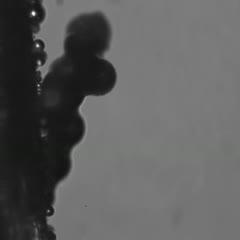
This image shows droplets coalescing around particles before jumping off wing.
(Photo Credit: Katrina Wisdom)
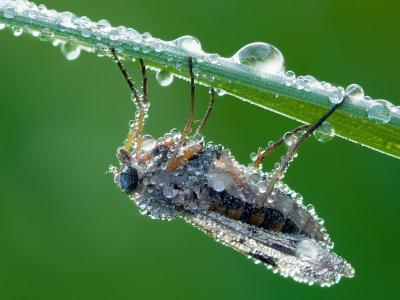
This image shows a dew-dropped cicada.
(Photo Credit: Duke University)
Source: Duke University