
A key protein, which may be activated to protect nerve cells from damage during heart failure or epileptic seizure, has been found to regulate the transfer of information between nerve cells in the brain. The discovery, made by neuroscientists at the University of Bristol and published in Nature Neuroscience and PNAS, could lead to novel new therapies for stroke and epilepsy.
Brain
New research from Mount Sinai Medical Center in New York reveals that repeated exposure to cocaine decreases the activity of a protein necessary for normal functioning of the brain's reward system, thus enhancing the reward for cocaine use, which leads to addiction. Investigators were also able to block the ability of repeated cocaine exposure, to induce addiction. The findings, published online April 22 in the journal Nature Neuroscience, provide the first evidence of how cocaine changes the shape and size of neuron rewards in a mouse model.
SAN DIEGO— Heart failure is the most common cause of death throughout the world, typically the result of chronic high blood pressure, also known as hypertension. As a result, research efforts have focused on an array of approaches aimed at preventing and treating high blood pressure. Recently, Japanese researchers examined the utility of an anti-hypertensive drug, moxonidine, which acts on the imidazoline receptors in the cardiovascular center of the brainstem.
NEW ORLEANS – Teasing out the exact type or types of dementia someone suffers from is no easy task; neurodegenerative brain diseases share common pathology and often co-occur. Researchers from the Perelman School of Medicine at the University of Pennsylvania are continuing efforts to differentiate diseases, such as Alzheimer's disease (AD) from frontotemporal lobar degeneration (FTLD), as FTLD is often clinically difficult to distinguish from atypical presentations of AD.
Your best side may be your left cheek, according to a new study by Kelsey Blackburn and James Schirillo from Wake Forest University in the US. Their work shows that images of the left side of the face are perceived and rated as more pleasant than pictures of the right side of the face, possibly due to the fact that we present a greater intensity of emotion on the left side of our face. Their work is published online in Springer's journal Experimental Brain Research.
Dr Barbara Fam from the University's Molecular Obesity Laboratory group at Austin Health with Associate Professor Sof Andrikopoulos have discovered that the liver can directly talk to the brain to control the amount of food we eat.
The results have demonstrated that the liver, which has never been classed as an important organ in controlling body weight before, is in fact a major player and should be considered a target for treatment of weight gain.
Grand Rapids, Mich. (April 19, 2012 ) – Researchers at Lund University in Sweden have discovered a new stem cell in the adult brain. These cells can proliferate and form several different cell types - most importantly, they can form new brain cells. Scientists hope to take advantage of the finding to develop methods to heal and repair disease and injury in the brain.
Scientist studying the way Alzheimer's takes root in the brain have identified important new similarities between a mouse model and human Alzheimer's.
Researchers at Washington University School of Medicine in St. Louis have shown that brain plaques in mice are associated with disruption of the ability of brain regions to network with each other. This decline parallels earlier results from human studies, suggesting that what scientists learn about Alzheimer's effects on brain networks in the mice will likely be transferable to human disease research.
INDIANAPOLIS — Neither screening for cognitive impairment nor screening followed by computerized alerts to the health care team improved patient outcome according to the first randomized, controlled study of care provided to hospitalized patients with cognitive impairment.
Carnivory is behind the evolutionary success of humankind. When early humans started to eat meat and eventually hunt, their new, higher-quality diet meant that women could wean their children earlier. Women could then give birth to more children during their reproductive life, which is a possible contribution to the population gradually spreading over the world.
The connection between eating meat and a faster weaning process is shown by a research group from Lund University in Sweden, which compared close to 70 mammalian species and found clear patterns.
Studying a mouse model of Alzheimer's disease, neuroscientists at the Technische Universitaet Muenchen have observed correlations between increases in both soluble and plaque-forming beta-amyloid – a protein implicated in the disease process – and dysfunctional developments on several levels: individual cortical neurons, neuronal circuits, sensory cognition, and behavior. Their results, published in Nature Communications, show that these changes progress in parallel and that, together, they reveal distinct stages in Alzheimer's disease with a specific order in time.
NASHVILLE, Tenn. – If you are an aging baby boomer and you've noticed it's a bit harder to drive to unfamiliar locations or to pick a new brand of olive oil at the supermarket, you can blame it on the white matter in your brain.
CHICAGO --- A new Northwestern Medicine brain-machine technology delivers messages from the brain directly to the muscles -- bypassing the spinal cord -- to enable voluntary and complex movement of a paralyzed hand. The device could eventually be tested on, and perhaps aid, paralyzed patients.
NEW ORLEANS – People who received injections of the multiple sclerosis (MS) drug interferon beta-1a soon after their first signs of possible MS were less likely to progress to clinically definite MS than people who switched to interferon beta-1a from placebo, according to new phase three results of the three-year REFLEXION clinical trial that will be presented as part of the Emerging Science program (formerly known as Late-Breaking Science) at the American Academy of Neurology's 64th Annual Meeting in New Orleans, April 21 to April 28, 2012.
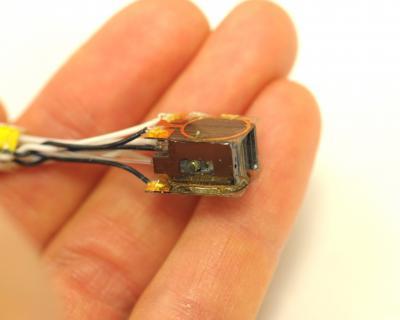
NIST's atom-based magnetic sensor, about the size of a sugar cube, can measure human brain activity. Inside the sensor head is a container of 100 billion rubidium atoms (not seen), packaged with micro-optics (a prism and a lens are visible in the center cutout). The light from a low-power infrared laser interacts with the atoms and is transmitted through the grey fiber-optic cable to register the magnetic field strength. The black and white wires are electrical connections.
(Photo Credit: Knappe/NIST)