
A recent paper highlights experimental research in evolution and artificial selection, providing insight into how organisms adapt to changing environmental conditions and fluctuations.
In this month's Physiological and Biochemical Zoology, Bradley S. Hughes, Alistair J. Cullum, and Albert F. Bennett (University of California, Irvine) explore the effect on E. coli of fluctuating acidity, an especially important environmental factor for the bacteria.
 Skull using MDCT. Credit: American Journal of Roentgenology
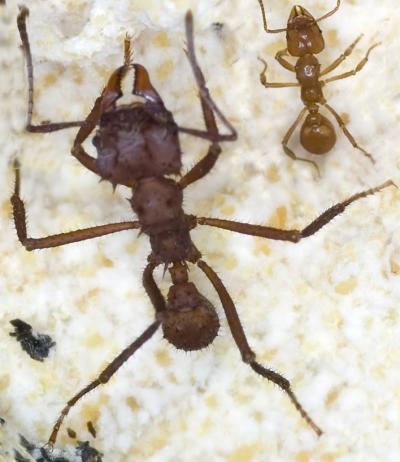 Research at the University of Leeds shows that despite an inherited genetic pre-disposition to grow into a particular worker caste, ant larvae can be triggered by environmental stimuli to switch development depending on colony's workforce needs.
  Researchers at Ohio University have found that after primates evolved the ability to see red, they began to develop red and orange skin and hair.