
Schal says that the pest-control arms race has mostly been about pests gaining resistance to the insecticides themselves. This paper, however, shows an arms race that includes behavioral resistance to certain types of food – in this case, glucose.
"Most times, genetic changes, or mutations, cause the loss of function," Schal says. "In this case, the mutation resulted in the gain of a new function – triggering bitter receptors when glucose is introduced. This gives the cockroach a new behavior which is incredibly adaptive. These roaches just got ahead of us in the arms race."
Ayako Wada-Katsumata, an NC State senior research scholar, performed most of the experiments and is the first author of the paper. She is now investigating whether roaches can learn to associate glucose with specific odors and thus use their memory to ignore baits that contain glucose. The research was supported by the National Science Foundation, the U.S. Department of Housing and Urban Development, and the Blanton J. Whitmire Endowment at NC State.

This movie shows the preferences of wild type and glucose-averse cockroaches for off-the-shelf store-bought foods with and without glucose.
(Photo Credit: Coby Schal, Jules Silverman, Ayako Wada-Katsumata)

The cockroach was deprived of food and water for 24 hrs, and screened. Before the assay the antennae, maxillary palps and labial palps were ablated, leaving the paraglossae intact, and then the paraglossae-mediated feeding response was obtained. The cockroach is offered a dyed stimulus solution containing D-glucose, and ingestion is also monitored through the clypeus and frons, the translucent front-middle area of the head capsule. The cockroach rejects D-glucose.
(Photo Credit: Coby Schal, Ayako Wada-Katsumata)
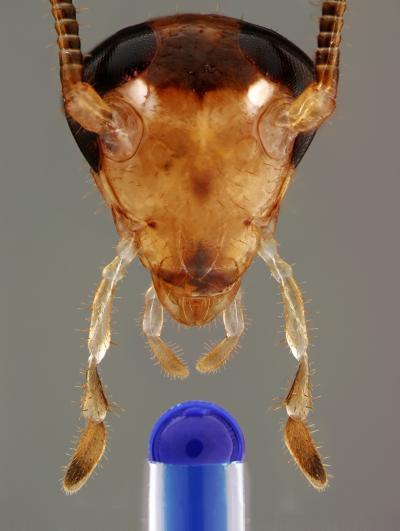
This is the head of a male German cockroach, showing the four major external chemosensory-paired appendages. The antennae extend upward (black compound eyes behind them), the longer maxillary palps and shorter labial palps extend downward, and the paired paraglossae are on either side of the mouth. Each appendage contains many sensory hairs, some of which function in gustation. A tastant is delivered to the mouth in a dyed (blue) drop of water.
(Photo Credit: Ayako Wada-Katsumata and Andrew Ernst)
Source: North Carolina State University