
Birds can be distinguished from other living reptiles by their brains, which are enlarged compared to body size. This "hyperinflation," most obvious in the forebrain, is important for providing the superior vision and coordination required to fly. But scientists are increasingly finding that features once considered exclusive to modern birds, such as feathers and the presence of wishbones, are now known to have first appeared in non-avian dinosaurs. The new study provides more evidence to add the hyperinflated brain to that list.
The researchers used CT scanners at the University of Texas, Ohio University, Stony Brook University, and the Museum to peer inside the braincases of more than two dozen specimens, including modern birds, Archaeopteryx, and closely related non-avian dinosaurs like tyrannosaurs. By stitching together the CT scans, the scientists created 3-D reconstructions of the skulls' interiors. In addition to calculating the total volume of each digital brain cast, the research team also determined the size of each brain's major anatomical regions, including the olfactory bulbs, cerebrum, optic lobes, cerebellum, and brain stem.
"The story of brain size is more than its relationship to body size," said coauthor Gabriel Bever, an assistant professor of anatomy at the New York Institute of Technology. "If we also consider how the different regions of the brain changed relative to each other, we can gain insight into what factors drove brain evolution as well as what developmental mechanisms facilitated those changes."
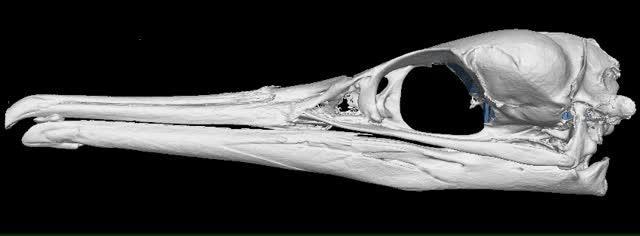
This video shows the three-dimensional scan of an albatross (Phoebastria immutabilis) skull and brain endocast (shown in blue) taken with high-resolution X-ray computed tomography. The specimen is one of more than two dozen skulls of modern birds, early extinct birds, and closely related dinosaurs scanned for a recent study on "bird brains" led by the American Museum of Natural History.
(Photo Credit: ©AMNH/A. Balanoff)
The researchers found that in terms of volumetric measurements, Archaeopteryx is not in a unique transitional position between non-avian dinosaurs and modern birds. Several other non-avian dinosaurs sampled, including bird-like oviraptorosaurs and troodontids, actually had larger brains relative to body size than Archaeopteryx.
"If Archaeopteryx had a flight-ready brain, which is almost certainly the case given its morphology, then so did at least some other non-avian dinosaurs," Balanoff said.
The researchers also examined another factor that is important to flight in modern birds: a neurological structure called the wulst, which is used in information processing and motor control. The team identified an indentation in the digital brain cast of Archaeopteryx that might be homologous to the wulst seen in living birds. But this indentation is not found in non-avian dinosaurs that have bigger brains than Archaeopteryx, presenting the research team with a new question to explore in the future.
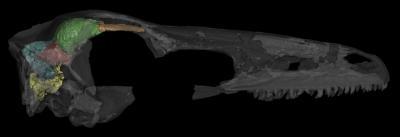
This CT scan shows the transparent skull and opaque brain cast of Zanabazar junior, a troodontid dinosaur. The endocast is partitioned into the following neuroanatomical regions: brain stem (yellow), cerebellum (blue), optic lobes (red), cerebrum (green), and olfactory bulbs (orange).
(Photo Credit: ©AMNH/A. Balanoff)
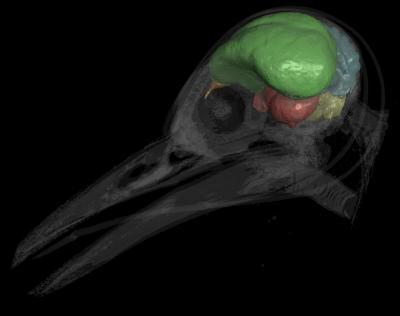
This CT scan shows a modern woodpecker (Melanerpes aurifrons) with its brain cast rendered opaque and the skull transparent. The endocast is partitioned into the following neuroanatomical regions: brain stem (yellow), cerebellum (blue), optic lobes (red), cerebrum (green), and olfactory bulbs (orange).
(Photo Credit: ©AMNH/A. Balanoff)