
Viator has recently signed a commercialization license to begin offering the device and method to scientists and academia for research. They are also preparing studies for FDA approval for clinical use, which is expected to take approximately two to three years. Viator says the final device will look similar to a desktop printer, and the costs to run the tests in a hospital would be a few hundred dollars.
"We are attempting to provide a faster and cheaper screening method, which is ultimately better for the patient and the physician," Viator said. "There are several melanoma drugs on the horizon. Combined with the new photoacoustic detection method, physicians will be able to use targeted therapies and personalized treatments, changing the medical management of this aggressive cancer. Plus, if the test is as accurate as we believe it will be, our device could be used as a standard screening in targeted populations."
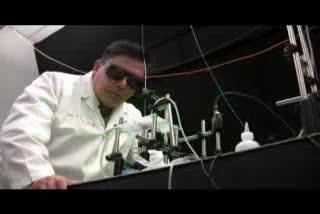
University of Missouri researchers are working to detect melanoma cancer at the cellular level, long before tumors have a chance to form. Commercial production of a device developed at MU that measures melanoma using photoacoustics, or laser-induced ultrasound, will soon be available to scientists and academia for cancer studies.
(Photo Credit: MU News Bureau)

John Viator, associate professor of biomedical engineering and dermatology in the Christopher S. Bond Life Sciences Center, says the photoacoustic device and method will provide an earlier diagnosis for aggressive melanoma cancers.
(Photo Credit: MU News Bureau)
Source: University of Missouri-Columbia