Bacteria study of male adolescents reveals new insights into urinary tract health

Posted By News On May 14, 2012 - 1:00pm
Bacteria study of male adolescents reveals new insights into urinary tract health

The first study using cultivation independent sequencing of the microorganisms in the adolescent male urinary tract has revealed that the composition of microbial communities colonizing the penis in young men depends upon their circumcision status and patterns of sexual activity.

This study, published Friday in the online journal PLoS One, is the first by Indiana University researchers working with a four-year, $7 million grant from the National Institutes of Health's Human Microbiome Project. It is also the first to reveal that urogenital bacterial communities of young men are surprisingly stable and that some of these bacteria are similar to species that colonize and protect healthy young women from sexually transmitted infections.

The research contradicts the accepted wisdom that pre-sexual men did not have bacteria in their urinary tracts.

"Young men had bacteria that looked similar to those of young healthy women," said David E. Nelson, Ph.D., an assistant professor of biology at Indiana University Bloomington and the principal investigator of the research. "We think that these bacteria may promote genitourinary health in men, just as they do in women. This contradicts previous dogma that only sexually transmitted pathogens colonize the male urethra."

The findings open doors for additional research that will lead to a deeper understand of men's health.

"This is the first real investigator of the normal microbiology of men before they begin sexual activity," Dr. Nelson said. "There are parallels between normal bacteria in young men and those in young women that are known to be protective."

This discovery was not possible before the mapping of the human genome and the development of powerful sequencing tools, said J. Dennis Fortenberry, M.D., M.S., principal investigator of the NIH grant and professor of pediatrics in the Division of Adolescent Medicine at the IU School of Medicine.
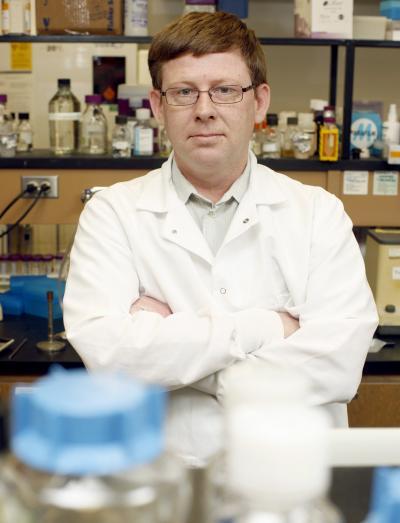
The first study using cultivation independent sequencing of the microorganisms in the adolescent male urinary tract has revealed that the composition of microbial communities colonizing the penis in young men depends upon their circumcision status and patterns of sexual activity.

(Photo Credit: Indiana University)

The investigators used the advanced sequencing techniques to evaluate bacteria on the head of the penis as well as in the urethra in 18 adolescents younger than 18 years, he said. The researchers will follow these adolescents, along with dozens of others, for several years to determine how the types and amounts of bacteria present in and on the penis changes over time.

This study reports that the types of bacteria found on the penis were different than what was found in the urethra, and the bacteria found in circumcised adolescents differed from the bacteria found in the uncircumcised adolescents. These differences may be important in understanding why circumcision helps prevent HIV and other sexually transmitted infections in men.

They also discovered changes in the bacteria after sexual activity began.

"We have some sense that some of the bacteria in the urethra are essential to keeping men healthy," Dr. Fortenberry said. "This research and the new technology will open doors to explore what is good about the bacteria, what they do and how."

"At this point in the research, we are asking 'chicken and egg' questions," Dr. Nelson said. "What comes first, the loss of normal bacteria, making a person more susceptible to sexually transmitted infections or, do you get colonized with other bacteria for some reason and that puts a person more at risk of contracting an STI."

This research, like other longitudinal studies, should shed light on the sequence of events that leads to STIs and other urinary tract diseases such as a common male condition called non-gonococcal urethritis, whose cause is unknown.

Drs. Fortenberry and Nelson said they decided that looking at the microbiome of a cohort of young, non-sexually active males was the only way to determine what bacteria was normal for men. Without that information, researchers can't determine the difference between healthy and unhealthy bacteria and know how to treat disease.

"bacteria found in circumcised adolescents differed from the bacteria found in the uncircumcised adolescents" In other words, natural boys have natural bacteria and cut boys have different invasive bacteria.

"These differences may be important in understanding why circumcision helps prevent HIV and other sexually transmitted infections in men." There are no real world studies that show cutting off penis parts helps prevent HIV and other sexually transmitted infections in men! In the US no lowering of HIV risk has been noted, and the US has a high circumcised adult population with a high HIV rate and Europe and Japan have a very low number of adults that are circumcised and have a very low HIV rate. There is clear evidence that baby boy penis parts removal does not shield the man the baby becomes from most types of STDs in developed nations.

This bacteria information is another important example as to how baby boy penis parts removal is harm!

Condoms and sensible sexual behaviour prevent the spread of HIV, not circumcision. The people of Europe have been doing just fine with uncircumcised penises for the last hundred years while you guys in the USA have been brutally removing foreskins from undeserving baby boys, supposedly in the name of better health. This study seems to suggest that bacteria in cut/intact penises are just 'different' and not one better than the other. Surely this is as good a reason as any - given the loss of sexual feeling and the sheer human rights of it all - to leave baby boys intact.

The longest running study of circumcision and STI's (a 29 year study of males in New Zealand) showed a slightly *higher* rate of STI's among circumcised men:
http://www.jpeds.com/article/S0022-3476(07)00707-X/abstract

The US, Ethiopia, and Israel have high circumcision rates. The rate in Ethiopia is 93%. All three countries have relatively high HIV rates.
Finland, Japan, and New Zealand don't routinely circumcise. They all have among the lowest HIV infection rates in the world.
The health of Australians has actually improved, since they stopped routinely circumcising in 1980.
It is unethical in the extreme, to remove a healthy body part from someone too young to give consent. When that involves removing half of their genital tissue, it really seems criminal. More than two thirds of Swedish doctors refuse to perform circumcisions.
Once you get past the pro-circumcision bias, there are some interesting discoveries in this article.

"These differences may be important in understanding why circumcision helps prevent HIV and other sexually transmitted infections in men." Circumcison does nothing of the sort it just disables the true function and protection of male genitalia.(Scientist get this stupidity out of your heads) Circumcison(Genital Mutilation) in Africa will spred the HIV Aids 10X what it is now.

I read these studies and the first thought is: "what is the agenda here?"

It is a scientific fact that bacterium, virals and fungals can not discern or discriminate between male and female cells and the medications used to treat females for these are equally effective for males.

This "urinary Tract Infection" justification has been parrotted since the infamous Wiswell study of the early 1980's. When Wiswell was discovered, he was removed from The AAP's Taskforce on Circumcision along with his friend,rabid supporter and Chair of the taskforce, Edgar Schoen. Wiswell chose all premature infants for his uncircumcised group and all full term infants for his circumcisied group. It is a confirmed fact that premature infants are at higher risk of UTIs. Wiswell constructed his study to reach the results he wanted.

Uncircumcised men secret two enzymes, langerin and lysozime from the foreskin that literally "eat" potentially harmful pathogens. Removing the foreskin cancels this immunological function.

Like Wiswell's study, the African HIV/AIDS studies were constructed to achieve and outcome. There is a long list of faults with the studies that have not been answered voiding the results. Additionally, history confirms that two leading researchers in the study have been promoting infant circumcision for more than 30 years. That is sufficient to seriously question the results as they appear to be a continuation of an agenda.

.

Post new comment

The content of this field is kept private and will not be shown publicly.
  • Allowed HTML tags: <em> <strong> <cite><p><br><i><b><center><ul><li><div><html5:figure><html5:figcaption>
  • Lines and paragraphs break automatically.

More information about formatting options

CAPTCHA
Sorry, we know you're not a spambot, but they're out there