
By manipulating the magnetization within a liquid solution, the Duke researchers coaxed magnetic and non-magnetic particles to form intricate nano-structures, such as chains, rings and lattices.
The nano-structures are formed inside a liquid known as a ferrofluid, which is a solution consisting of suspensions of nanoparticles composed of iron-containing compounds. One of the unique properties of these fluids is that they become highly magnetized in the presence of external magnetic fields. The particles that are less magnetic than the ferrofluid behave similarly to negative charges, whereas the particles that are more magnetic than the ferrofluid act like positive charges. The opposite particles thus attract one another to form structures resembling salt crystals.
Since the magnetization of the fluid and the concentrations of the particles controls how the particles are attracted to or repelled by each other, the researchers were able to control the shapes and patterns of assembly. By appropriately "tuning" these interactions, the magnetic and non-magnetic particles form around each other much like a snowflake forms around a microscopic dust particle.
According to Yellen, researchers have long been able to create tiny structures made up of a single particle type, but the demonstration of sophisticated structures assembling in solutions containing multiple types of particles has been difficult to achieve. The structure of these nano-structures determines how they can ultimately be used.
Yellen foresees the use of these nano-structures in advanced optical devices, such as sensors, where different nano-structures could be designed to possess custom-made optical properties. Yellen also envisions that rings composed of metal particles could be used for antenna designs, and perhaps as one of the key components in the construction of materials that display artificial "optical magnetism" and negative magnetic permeability.
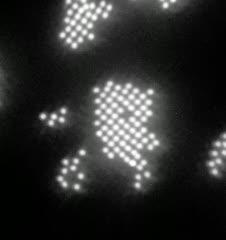
This is a video of a nano-structure.
(Photo Credit: Benjamin Yellen)
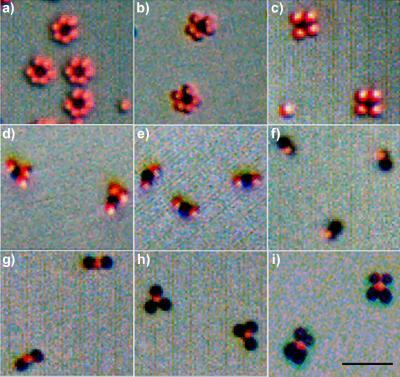
This is a nano-structure.
(Photo Credit: Benjamin Yellen)
Source: Duke University