
Tsukuba, Japan - A persistent controversy in catalysts for fuel cells has just been solved by a team of researchers from the Faculty of Pure and Applied Sciences at the University of Tsukuba.
Earth
An analysis of long-term, water quality monitoring data reveals that climate change is already having an impact on ecosystems in the coastal waters of Buzzards Bay, Mass. The impacts relate to how nitrogen pollution affects coastal ecosystems.
CAMBRIDGE, MA - One of the biggest obstacles to making fusion power practical -- and realizing its promise of virtually limitless and relatively clean energy -- has been that computer models have been unable to predict how the hot, electrically charged gas inside a fusion reactor behaves under the intense heat and pressure required to make atoms stick together.
Researchers at the University of Jyväskylä, Finland, and Colorado State University, USA, have for the first time ever determined the dynamical behaviour of the ligand layer of a water-soluble gold nanocluster in solution. The breakthrough opens a way towards controllable strategies for the functionalisation of ligated nanoparticles for applications. The work at the University of Jyväskylä was supported by the Academy of Finland. The research was published in Nature Communications on 21 January 2016. (1)
An eight-hour experiment using the ALPHA trap at CERN confirmed with 20 times greater precision than before that the charge of the antihydrogen atom -- the antimatter counterpart of the hydrogen atom -- is zero.
The charge is identical to that of the hydrogen atom, once again demonstrating that the properties of antimatter and matter are mirror images of one another.
Using molecular dynamics simulations, researchers have analysed the properties of supercritical water. The researchers showed which structure of the hydrogen bond network is formed in different supercritical states and also simulated the relevant terahertz spectra. This approach may help in future to interpret experimental results.
James Joyce, Julio Cortazar, Marcel Proust, Henryk Sienkiewicz and Umberto Eco. Regardless of the language they were working in, some of the world's greatest writers appear to be, in some respects, constructing fractals. Statistical analysis carried out at the Institute of Nuclear Physics of the Polish Academy of Sciences, however, revealed something even more intriguing. The composition of works from within a particular genre was characterized by the exceptional dynamics of a cascading (avalanche) narrative structure. This type of narrative turns out to be multifractal.
You grab for the cough syrup for some relief from that nasty lingering cold, what do you measure the dose with? Many of us use teaspoons or table spoons to measure out doses for ourselves and our children but this results in dosage errors! This new study finds that errors in estimating doses can be mitigated by changing the serving measurements on the dosage facts panel from teaspoons to milliliters.
From the polyurethane that makes our car seats to the paper made from bleached wood pulp, chlorine can be found in a variety of large-scale manufacturing processes. But while chlorine is good at activating the strong bonds of molecules, which allows manufacturers to synthesize the products we use on a daily basis, it can be an insidious chemical, sometimes escaping into the environment as hazardous byproducts such as chloroform and dioxin.
TORONTO, January 20, 2016 - Scientists of the international ALPHA Collaboration have once again pushed the boundaries of antimatter research with their latest breakthrough studying the properties of antihydrogen. Published today in the prestigious journal Nature, the collaboration's result improved the measurement of the charge of antihydrogen, essentially zero, by a factor of 20.
NASA's RapidScat instrument found the strongest winds in Tropical Cyclone Victor were occurring south of its center on Jan. 20, 2016. Imagery from NOAA's GOES-West satellite revealed that Victor still maintained hurricane-strength and an eye.
As Victor continues moving in a southerly direction a gale warning was posted for the island country of Niue. Tonga is located to the west and the Cook Islands to the east.
UNSW Australia researchers have found that carbon dioxide concentrations in seawater could reach levels high enough to make fish "intoxicated" and disoriented many decades earlier than previously thought, with serious implications for the world's fisheries.The UNSW study, published in the journal Nature, is the first global analysis of the impact of rising carbon dioxide emissions from fossil fuels on natural variations in carbon dioxide concentrations in the world's oceans.
At the recent COP21 climate conference in Paris, delegates reached an agreement that plans to limit global warming to "well below" two degrees Celsius. This stems from the fact that scientists and politicians now agree: the global average temperature must rise by no more than two degrees if we are to prevent serious, irreversible damage to humans and the environment.
Montreal, Jan. 20, 2016 -- Earth's temperature has increased by 1°C over the past century, and most of this warming has been caused by carbon dioxide emissions. But what does that mean locally?
A new study published in Nature Climate Change pinpoints the temperature increases caused by CO¬2 emissions in different regions around the world.
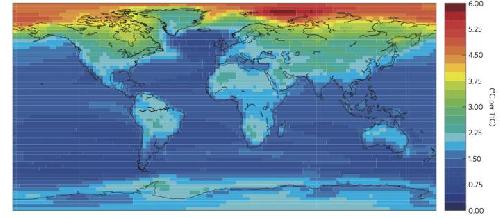 This is a map of climate change. Credit: Nature Climate Change
The cost burden of Quebec's carbon-pricing policy, is likely to be modest across income groups and industries, according to a McGill University research team.
The policy, which began to be implemented in 2013, provides a model for capping emissions "without undue hardship for the population," the researchers conclude. If anything, they suggest, the program could be more aggressive in seeking to cut emissions. Their findings are reported in the December issue of Canadian Public Policy.